
We find ourselves in an increasingly hostile environment for social networking. States are increasingly requiring identity verification to access online social spaces, ostensibly to protect our children. This is a dangerous road to go down if we value our freedom of expression and association. When a state can decide who we talk to and how we speak to them, we are one step closer to the government controlling our communications. It’s one thing for a small community to decide on its standards, and another for the government to dictate those standards.
If the states are honest about their goal of protecting our youth, we have a few ways to achieve that while protecting our identity. Some of these are not worth doing on social networks with large numbers of people spread around the world, but if we break the network into many small local communities, it becomes much easier to manage. Each small community has its own moderators and support group, so the number of moderators and support staff scales with the number of communities and, thus, with the number of participants.
If the important thing is that people be adults, we can let them register for an account and then show up in person to prove they are an adult. This works well when the social network serves a local community. Everyone can go to the local coffee shop, wave, chat briefly, and have their account marked as verified as an adult. If the person appears too young, they may need to show ID, but only to confirm they are an adult. Nothing needs to be recorded other than a flag indicating that the account is associated with an adult.
If states require an audit trail linking the verified account to a real-world identity, we can take a page from the notary public: keep a paper book that records the account name and ID, and have the person presenting the ID sign the book. The record exists, but it isn’t vulnerable to hacking the way it would be if it were all online.
What could be the benefits of this kind of verification? For starters, linking an account to a real-world ID for a local community means that if the account holder loses their password, they can go to the coffee shop, present their ID, and have their account password reset. Verified accounts receive more benefit of the doubt when moderating, with a conversation with the account holder rather than an immediate block. It also means that if the account holder violates the rules and is banned, it’s easier to prevent them from creating another verified account in the same community. This could make moderation slightly easier because, behind the scenes, there’s less anonymity. Or, anonymous accounts don’t benefit from being a trusted part of the community the way verified accounts might.
If you’d like to set up a social network for your community, go for it! The beauty of the Fediverse is that anyone can set up a server without asking permission. There are some caveats: you need to decide on the software you want to use and where you want to run it. You need a domain name. If you want others to join, you need to get the word out that they are welcome on the server. You need to curate your community by vetting accounts, moderating content, and blocking harmful communities; people trust you to ensure it is a safe space. Not moderating betrays that trust.
Resources
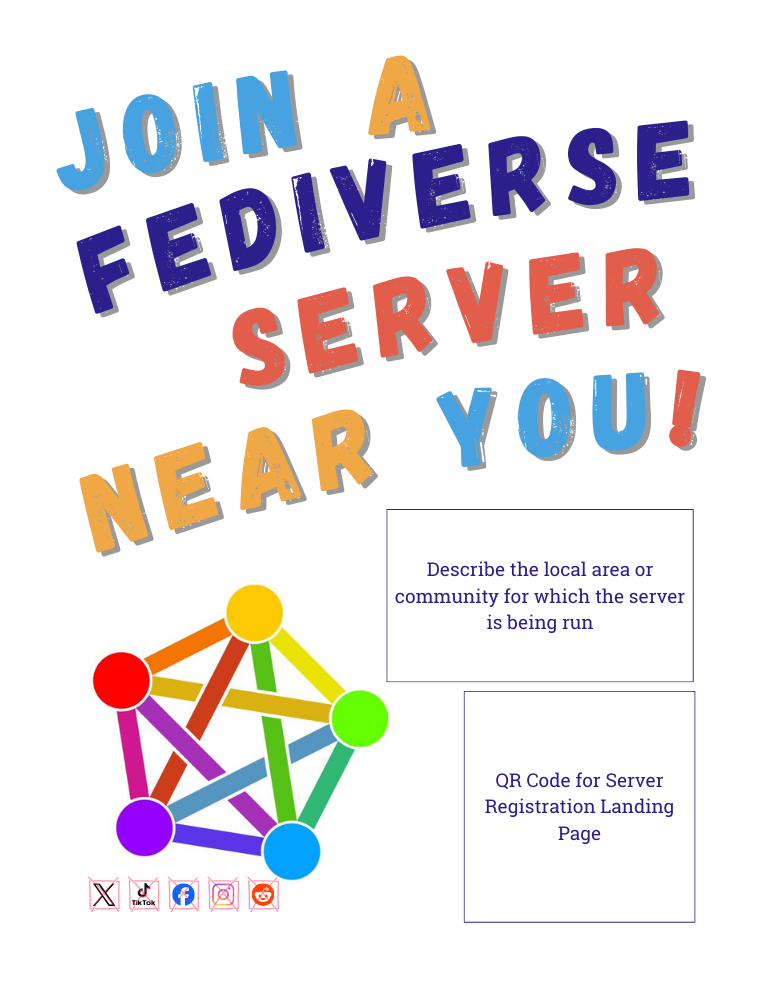
Here are some resources to help you get started.
Many communities use Mastodon to replicate the original Twitter experience, to some degree. It is easy to find hosting without managing a web server yourself. For example, Masto.host makes it easy to get started with just a few clicks and a credit card.
The Mastodon administrator community has compiled lists of instances that many administrators block for hate speech, harassment, and other violations of standard server rules. A good place to start is Garden Fence. You can also follow the #fediblock hashtag to see what other instance administrators are sharing.
You’ll also want to limit signups so that people must undergo a manual review before being activated. This helps limit bot and spam accounts and ensures people have some connection to the local community.
Get the word out to your neighborhood. Create fliers and post them in high-traffic areas where people can see them (feel free to use the example poster). As part of this, set up unofficial “office hours” at a local coffee shop or another third place where people can find you and have their accounts verified.
If you set up a local community instance, follow empathyforward@charities.place and let us know!
